

Enterprise Software Licensing Guide 2025: What You Need to Know


Enterprise software licensing can chew up as much as 22 percent of your IT budget every year. Surprised? Most leaders think compliance headaches or expensive audits are the big worries. Turns out, the real win comes from knowing which license model fits your business—because choosing wisely can save you up to 35 percent on procurement costs and keep your tech future proof.
Table of Contents
- Understanding Enterprise Software Licensing Models
- Key Compliance And Audit Considerations
- Choosing The Best License For Your Organization
- Best Practices For Managing Software Licenses
Quick Summary
| Takeaway | Explanation |
| Understanding Licensing Models is Key | Recognize the differences between perpetual, subscription, and concurrent user licensing models to align software access with organizational needs and usage patterns. |
| Proactive Compliance is Essential | Implement regular internal audits and a Software Asset Management (SAM) program to maintain compliance and mitigate risks, transforming compliance from a reactive challenge to a strategic capability. |
| Tailor Licensing to Organizational Size | Different sizes of organizations require distinct licensing strategies; small businesses often benefit from per user licensing while larger enterprises may need flexible, enterprise-wide options. |
| Focus on Total Cost of Ownership | Assess not just the initial cost but ongoing expenses, compliance penalties, and scalability to understand the financial impact of different licensing models. |
| Embrace Technology for License Management | Utilize centralized tracking systems and automated tools to gain visibility into software assets and optimize licensing strategies, reducing costs and preparing for audits. |
Understanding Enterprise Software Licensing Models
Enterprise software licensing represents a complex ecosystem of legal agreements that define how organizations acquire, use, and manage software solutions. These models determine the financial and operational framework through which businesses access critical technological resources.
Types of Enterprise Software Licensing Structures
The landscape of enterprise software licensing encompasses several core models that cater to different organizational needs and usage patterns. Perpetual licensing remains a traditional approach where businesses purchase software with a one time payment and receive indefinite usage rights. This model typically includes initial support and updates for a specified period.
Subscription based licensing has emerged as a dominant model in recent years, offering more flexible and scalable options for enterprises. Gartner reports that over 70% of enterprise software vendors now prefer subscription models, which provide continuous updates, cloud integration, and predictable monthly or annual costs.
Another critical model is concurrent user licensing, where organizations purchase a set number of simultaneous software access points. This approach allows businesses to optimize software investment by enabling multiple employees to share limited licenses based on actual usage patterns. IDC indicates that concurrent licensing can reduce software procurement costs by up to 35% for medium to large enterprises.
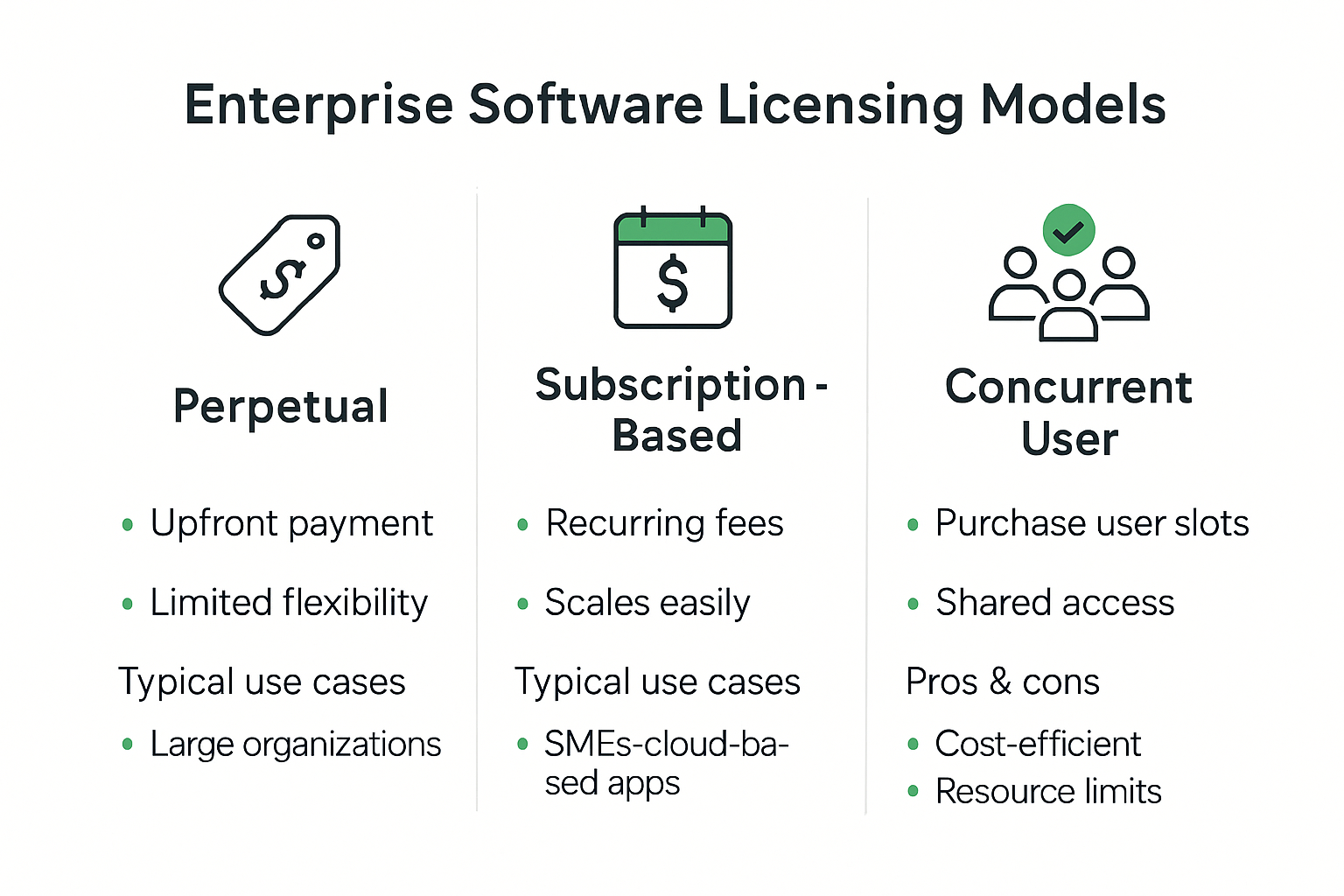
To help you compare the main enterprise software licensing models, the following table summarizes their core characteristics, financial structure, and typical benefits:
| Licensing Model | Payment Structure | Key Benefits | Typical Use Case |
| Perpetual | One-time upfront payment | Indefinite usage, predictable costs, stability | Stable environments, long-term use |
| Subscription | Recurring (monthly/annual) | Continuous updates, low initial cost, scalable, cloud-ready | Organizations needing flexibility |
| Concurrent User | Pay for max simultaneous use | Cost efficiency for shared access, aligns with real usage | Medium/large orgs with variable usage |
Key Considerations in Enterprise Software Licensing
Navigating enterprise software licensing requires careful strategic planning. Organizations must evaluate several crucial factors:
- Scalability: Selecting licensing models that can expand or contract with organizational growth
- Compliance: Ensuring strict adherence to vendor terms and avoiding potential legal complications
- Cost Effectiveness: Analyzing total cost of ownership beyond initial procurement expenses
Forrester Research suggests that enterprises spend an average of 6 8% of their IT budget on software licensing, making it a significant financial consideration. The right licensing strategy can help businesses optimize technological investments while maintaining financial flexibility.
Modern enterprise software licensing increasingly emphasizes flexibility, cloud integration, and value driven approaches. Successful organizations treat licensing not as a transactional process but as a strategic decision that aligns technological capabilities with business objectives.
Understanding these nuanced licensing models empowers businesses to make informed decisions, control costs, and leverage software resources more effectively. As technology continues to evolve, so too will the sophisticated approaches to software licensing and access management.

Key Compliance and Audit Considerations
Enterprise software licensing compliance represents a critical operational challenge that extends far beyond simple software acquisition. Organizations must navigate a complex landscape of legal requirements, vendor regulations, and internal governance protocols to maintain effective software asset management.
Software License Audit Fundamentals
Software license audits have become increasingly sophisticated and frequent in recent years. Deloitte reports that over 65% of enterprises will face at least one formal software licensing audit annually. These comprehensive reviews examine an organization’s software usage, deployment, and adherence to licensing agreements.
The primary objectives of software license audits include:
- Verification of Usage: Confirming that actual software deployment matches purchased licensing terms
- Compliance Confirmation: Ensuring the organization meets all contractual obligations
- Risk Mitigation: Identifying potential licensing gaps or unauthorized software usage
Legal and Financial Risks of Non Compliance
Non compliance with software licensing agreements can result in significant financial and legal consequences. PwC indicates that organizations may face penalties ranging from 20% to 200% of the estimated licensing value for improper software usage.
Key risk areas include:
- Unexpected financial liabilities from retroactive licensing fees
- Potential legal actions by software vendors
- Potential termination of critical software agreements
- Reputational damage within the industry
Proactive Compliance Strategies
Successful organizations implement robust software asset management strategies to mitigate compliance risks. Gartner recommends a comprehensive approach that includes:
- Regular internal software usage audits
- Centralized software procurement and tracking systems
- Clear organizational policies for software acquisition and deployment
- Continuous monitoring of software license inventories
Implementing a Software Asset Management (SAM) program can help organizations maintain precise control over their software licensing landscape. This approach transforms compliance from a reactive challenge to a strategic organizational capability.
Technology continues to evolve, making software licensing compliance an increasingly complex discipline. Successful enterprises view compliance not as a burden but as an opportunity to optimize technological investments, manage risks, and maintain operational excellence.
By developing a proactive and systematic approach to software licensing compliance, organizations can protect themselves from potential financial and legal risks while ensuring maximum value from their technological investments.
Choosing the Best License for Your Organization
Selecting the appropriate software licensing model is a strategic decision that directly impacts an organization’s technological capabilities, financial performance, and operational flexibility. The right licensing approach can significantly enhance productivity and cost effectiveness.
Organizational Size and License Model Alignment
Different organizational sizes require distinct licensing strategies. Forrester Research indicates that small businesses, mid market companies, and large enterprises have unique software licensing requirements that demand tailored approaches.
For small businesses, per user licensing often provides the most cost effective solution. This model allows organizations to pay only for the number of employees who need software access. Mid market companies frequently benefit from volume licensing which offers discounted rates for multiple software installations.
Large enterprises typically require more complex licensing models that provide:
- Flexible deployment options
- Enterprise wide software access
- Comprehensive support agreements
- Scalable infrastructure compatibility
To clarify alignment between organization size and suitable license models, the table below summarizes recommended approaches and their primary reasons:
| Organization Size | Typical Preferred License Model | Main Rationale |
| Small Business | Per User Licensing | Cost control, pay only for used access |
| Mid-market Company | Volume Licensing | Discounted rates, multiple installations |
| Large Enterprise | Enterprise-wide/Complex Licensing | Flexibility, scale, comprehensive terms |
Financial Considerations and Total Cost of Ownership
Gartner reveals that organizations spend approximately 22% of their IT budget on software licensing. Understanding the total cost of ownership becomes crucial when evaluating different licensing models.
Key financial factors to consider include:
- Initial procurement expenses
- Ongoing maintenance costs
- Upgrade and update fees
- Potential penalties for non compliance
- Scalability expenses
Subscription based models often provide more predictable financial planning, with consistent monthly or annual expenses. Perpetual licensing might require larger upfront investments but can offer long term cost benefits for stable software environments.
Technology Infrastructure and Future Readiness
Modern licensing decisions must account for emerging technological trends. IDC suggests that cloud based and hybrid licensing models are becoming increasingly important for organizations seeking flexibility and innovation.
Consider these critical technological factors:
- Cloud compatibility
- Integration capabilities
- Remote work support
- Scalability of infrastructure
- Future technological adaptability
Successful license selection goes beyond immediate needs. Organizations must anticipate future technological shifts, workforce changes, and potential business model transformations.
The ideal licensing strategy balances immediate operational requirements with long term strategic objectives. By carefully evaluating organizational size, financial constraints, and technological infrastructure, businesses can develop a licensing approach that supports growth, innovation, and operational efficiency.
Remember that no universal licensing model fits every organization. Continuous assessment, flexibility, and strategic planning remain key to effective software asset management.
Best Practices for Managing Software Licenses
Effective software license management represents a critical strategic function for organizations seeking to optimize technological investments and maintain regulatory compliance. The complexity of modern software ecosystems demands a sophisticated and proactive approach to license tracking, optimization, and governance.
Centralized License Inventory and Tracking
Gartner emphasizes that successful software license management begins with comprehensive inventory and tracking mechanisms. Organizations must develop a centralized system that provides real time visibility into software assets, usage patterns, and licensing agreements.
Key components of an effective tracking system include:
- Automated discovery tools that identify all software installations
- Detailed license repository documenting purchase dates, terms, and usage rights
- Regular reconciliation processes to ensure accuracy
- Integration with procurement and IT management systems
Implementing advanced tracking mechanisms allows businesses to:
- Identify unused or underutilized software licenses
- Prevent unauthorized software installations
- Optimize software spending
- Prepare for potential vendor audits
Proactive Compliance and Optimization Strategies
Deloitte reports that organizations can reduce software costs by up to 30% through strategic license management. Proactive strategies involve continuous monitoring, regular assessments, and strategic license portfolio management.
Critical optimization approaches include:
- Periodic license usage audits
- Negotiating flexible licensing terms
- Implementing software rationalization processes
- Developing clear software procurement policies
Technology and Governance Framework
IDC suggests that successful license management requires a robust technological and governance framework. Organizations must develop comprehensive policies that address:
- Software acquisition protocols
- Usage monitoring mechanisms
- Compliance reporting systems
- Risk management strategies
Modern software license management transcends simple tracking. It requires a holistic approach that integrates technological tools, organizational policies, and strategic planning.
Successful enterprises view license management as a dynamic process that continuously adapts to changing technological landscapes. By implementing sophisticated tracking, optimization, and governance strategies, organizations can transform software licensing from a potential risk into a strategic advantage.
The most effective license management approaches combine technological solutions with human expertise, creating a comprehensive system that maximizes software value while minimizing financial and legal risks.
Frequently Asked Questions
What are the main types of enterprise software licensing models?
The main types of enterprise software licensing models include perpetual licensing, subscription-based licensing, and concurrent user licensing. Perpetual licensing offers indefinite usage for a one-time payment, subscription-based licensing provides flexibility with recurring payments and continuous updates, while concurrent user licensing allows limited simultaneous access based on actual usage.
How can organizations ensure compliance with software licensing agreements?
Organizations can ensure compliance by implementing a Software Asset Management (SAM) program, conducting regular internal audits, maintaining centralized software tracking systems, and establishing clear policies for software procurement and deployment.
What are the financial risks of non-compliance with software licensing?
The financial risks of non-compliance include potential penalties ranging from 20% to 200% of the estimated licensing value, unexpected liabilities from retroactive licensing fees, and reputational damage in the industry. Legal actions from vendors can also occur.
How should organizations choose the right software licensing model for their size?
Organizations should align their licensing model with their size and needs. Small businesses often benefit from per user licensing to control costs, mid-market companies prefer volume licensing for discounts, and large enterprises require complex licensing models that provide flexibility, scalability, and comprehensive support.
Simplify Enterprise Software Licensing with Certified Microsoft Solutions
Struggling to manage compliance risks or uncertain if you are paying too much for licenses? If the guide made you concerned about tracking software assets or facing unexpected audit penalties, you are not alone. Many businesses end up overwhelmed by complex license models, unpredictable costs, and the pressure to keep up with evolving compliance standards. The right licensing decisions are crucial for budget control and future-proofing your organization.
Choose peace of mind and unlock value with genuine Microsoft products from ONDAPRO.ME. As a Microsoft Authorized Reseller, we deliver verified operating systems, productivity suites, and enterprise tools tailored for your exact needs. Visit our home page to find the perfect fit for your business or explore our solutions to take control of your licensing strategy. Act now to secure compliance and optimize your IT investment before your next renewal or audit.



 Office
 Office for Mac
 Windows
 Project
 Visio
Visio Windows Server